FOR EMPLOYERS
Protecting the wellbeing of employees is a basic workplace health and safety requirement that includes ensuring that workplaces are psychologically safe. Many workplace laws have been rewritten to introduce regulations to prevent workplace psychological hazards and injuries. Strengthened occupational health and safety (OHS) frameworks recognise that hazards that pose a risk to psychological health are no less harmful to employees' safety and wellbeing than physical hazards. While the term psychological safety is often used, many may not be aware of what is meant by psychological safety and how this applies to the employment of provisional psychologists. When we take steps to protect the psychological wellbeing of provisional psychologists, it not just benefits them, but it also benefits the community which they are working with. A psychologically safe workplace does not happen by chance. There are practical and intentional measures put in place to control, eliminate, or minimise psychological hazards in the workplace.
What do we mean by Psychological Safety?
A psychologically safe workplace designs and manages strategies to prevent work-related stress for their employees. While stress itself does not constitute a psychological injury, those who are exposed to prolonged and/or severe stress may be susceptible to both psychological and physical injuries.
Psychological safety also means employees feel they can share their thoughts and feelings without the risk of damaging their reputation or standing. In psychologically safe workplaces, employees feel accepted and respected. Employees need to feel like they belong and are accepted before they’re able to achieve their potential in the workplace. According to Dr. Timothy Clark, (Clark, 2020) employees progress through the following 4 stages.
Stage 1 — Inclusion Safety: In this stage, employees feel safe to be themself and are accepted for who they are, including their unique attributes and defining characteristics. They feel connected and a sense of belonging.
Stage 2 — Learner Safety: In this stage, employees feel safe to exchange in the learning process by asking questions, giving and receiving feedback, experimenting, and making mistakes. They can learn and grow.
Stage 3 — Contributor Safety: Employees feel safe to use their skills and abilities to make a meaningful contribution. They feel like they make a difference.
Stage 4 — Challenger Safety: Employees feel safe to speak up and challenge the status quo when they think there’s an opportunity to change or improve. They feel like they can make things better.
Increasing the psychological safety for provisional psychologists will improve their practice, allow for growth and development, and reduce the potential for ethical breaches. As they feel more open to sharing the challenges they are facing, education opportunities increase as well as their workplace performance.
A lack of psychological safety at work has major consequences. It puts employees at risk of psychological injury. There are many potential psychological hazards in the workplace that need to be considered when employing a provisional psychologist.
What are the psychological hazards for provisional psychologists?
- High job demands: This may include long work hours, high caseloads, and working with complex clients.
- Inadequate support: Provisional psychologists benefit from having both support in the workplace by a senior psychologist and access to regular supervision. They also require information and training to support their work performance and emotional support from their team.
- Low job control: When provisional psychologists have little control over aspects of their work, including hours of work, or not having sufficient input in working with particular clients.
- Poor workplace relationships: Where there is bullying, harassment, discrimination, or other unreasonable behaviour by co-workers, supervisors or clients. Where there are poor relationships between employees and their managers or a lack of fairness and equity.
- Low role clarity: It is important that provisional psychologists have clarity about work standards, tasks, and responsibilities.
- Low recognition and reward: Having inadequate feedback, lack of opportunity for skills development, and lack of formal recognition for effort made.
- Remote and isolated work: Work where there are no or few people around to access support.
- Secondary or vicarious trauma: There are risks involved with working as a psychologist at all stages of our career. However, provisional psychologists may be particularly susceptible due to being in early-career and therefore having fewer skills and competencies to manage and process traumatic information.
- Power imbalance: Supervisors are expected to be the gatekeepers of the profession and act to increase the safety of the public by ensuring that provisional psychologists are practising in evidence-based and ethical ways with their clients. Provisional psychologists will already be experiencing an imbalanced power dynamic because of the role that supervisors play in protecting the public. This may lead to fear from the provisional psychologist in their ability to turn down work, address challenges in the workplace, set boundaries around reasonable caseloads, etc. Provisional psychologists may fear that they will fail their internship or receive negative feedback on their progress reports if they speak up.
- Potential for working outside of scope: As provisional psychologists are in the early stages of their careers, they will likely be lacking in experience working with any population. Clients need to be chosen for provisional psychologists that are less complex and matched to an individual's ability and competence so that they can gain experience without negatively affecting the safety of the public. Most provisional psychologists will develop their skills and competencies best when working with mild to moderate presentations. For further information please see: Safe Work Australia, Model Code of Practice - Managing Psychosocial Hazards at Work.
For further information please see: Safe Work Australia, Model Code of Practice - Managing Psychosocial Hazards at Work.
How do I increase psychological safety in the workplace?
- Review the occupational health and safety laws in your jurisdiction and know the responsibilities of a workplace to prevent workplace psychological hazards and injuries.
- Make psychological safety an explicit priority and discuss it often.
- Don’t make assumptions about what skills you think a provisional psychologist should already have. Use curious enquiry.
- Model help-seeking behaviour and open discussion of the challenges of working in this industry.
- Give space for everyone to speak up. Make this a regular occurrence.
- Allow time in schedules for provisional psychologists to engage in reflection and evaluation of their practice.
- Don’t give provisional psychologists high caseloads or caseloads that are too complex for their level of experience.
- Have ways to review when provisional psychologists are not doing well and how the workplace can support them.
- Don’t push conflict “under the rug.” Have healthy discussions when there are disagreements in the workplace. Allow employees to work through any issues that they have in productive ways.
- Make case reviews a standard practice.
- Give and receive feedback from others well.
- Create space for new ideas and doing things differently.
What to consider when employing a provisional psychologist
- Provisional psychologists undertaking the 4+2 pathway and the 5+1 pathway have a range of competencies they need to meet before being eligible for full registration.
- Internship guidelines dictate that a full-time caseload is 35 hours per week which comprises 14 hours of client contact and 21 hours of client-related activities. This is a ratio of 40/60, with only 40% of the internship being expected to be involving direct client contact. As provisional psychologists are employees, their time at work should be remunerated.
- A caseload limit of seeing 3-4 clients per day, 4-5 days per week is appropriate for those working full-time. This creates the best learning for early-career psychologists and allows for sufficient time to undertake case noting, treatment planning, report writing, research on psychological presentations they are treating, etc.
- Early-career psychologists are at risk for burnout due to the demands of the internship program, and therefore, ethically speaking, we need to consider not just their psychological wellbeing but the community/clients they are working with.
- If the business owner or manager also wants to be the primary supervisor of the provisional psychologist, careful consideration should be given to any potential obstacles and challenges particularly dual relationships. If it can’t be avoided, it would be best to address the dual relationship at the commencement of supervision and work out a plan to problem-solve any foreseeable challenges this may create.
- The majority of provisional psychologists learn best when they are seeing mild-moderate presentations. Employers need to be mindful of the skill set of each employee. As per the psychology ethical code regarding competence, psychologists should only see clients they are skilled to see. When psychologists don’t have adequate skills in certain areas, they need to undertake training and receive adequate supervision to ensure they are minimising the risk of harm to the client. Consider the referrals and client being assigned to the provisional psychologist and whether the workplace will be able to arrange adequate training and supervision or referral to another psychologist should the client presentation be outside of the individual’s scope of practice.
FOR PROVISIONAL PSYCHOLOGISTS
Provisional Psychologists Rights
All employees have workplace rights. Provisional psychologists are often unsure of what their rights are in the workplace. Legislation about workers’ rights can be complex but it is a requirement that employers understand their obligations or seek expert advice where needed. Some key points to consider:
- Fair pay – Fair Work Australia publishes award payments that are relevant for provisional psychologists. Most provisional psychologists would be paid under the Health Professionals and Support Services Award. These are minimum legal requirements.
- There are other workplace rights.
- Everyone has a right to a workplace free from bullying, sexual harassment and discrimination.
- There are ethical obligations if you are employed by a psychologist. Relevant section of the Psychology Board Code of ethics include:
B.6. Delegation of professional tasks
Delegation of professional tasks Psychologists who delegate tasks to assistants, employees, junior colleagues or supervisees that involve the provision of psychological services:
(a) take reasonable steps to ensure that delegates are aware of the provisions of this Code relevant to the delegated professional task;
(b) take reasonable steps to ensure that the delegate is not in a multiple relationship that may impair the delegate’s judgement;
(c) take reasonable steps to ensure that the delegate’s conduct does not place clients or other parties to the psychological service at risk of harm, or does not lead to the exploitation of clients or other parties to the psychological service;
(d) take reasonable steps to ensure that the delegates are competent to undertake the tasks assigned to them; and
(e) oversee delegates to ensure that they perform tasks competently.
C.4. Non-exploitation
C.4.1. Psychologists do not exploit people with whom they have or had a professional relationship.
C.4.2. Psychologists do not exploit their relationships with their assistants, employees, colleagues or supervisees.
- Provisional psychologists require adequate supervision. If a provisional psychologist is not receiving adequate support in the workplace to feel comfortable doing their job, it is important that this is raised and support is increased.
- Reasonable levels of work. The Psychology Board of Australia recommends a ratio of 14 hours of face-to-face work and 21 hours of client-related work each week (based on the hours required of each to complete the internship).
- Disability discrimination act requires that reasonable adjustments be made available to any provisional psychologists with disabilities. See JobAccess for further information about what supports are available to you. Caseloads that are reasonable regarding complexity based on an individual’s level of experience and training.
Where can you go for help?
- AAPi has a member advisory service. If you are concerned about something that is happening in your workplace you can contact this service through calling reception on 0488 770 044, email [email protected] or submit a web inquiry here.
- AAPi members have access to a free initial workplace advice call through our partner WorkPlacePLUS to discuss any HR issues affecting you or your workplace. You can contact Anna from WorkPlacePLUS by phone 03 9492 0958 or email [email protected]. Please have your member number ready when you make contact.
- There are many social media groups that have been created to support provisional and early career psychologists. Many find that accessing these is a good source of support and guidance.
- AAPi has an Early Career and Provisional Psychologist Forum that you can access for additional support. Find the forum here.
- The Fair Work Commission website - Australia's national workplace relations tribunal.
- The Fair Work Ombudsman website.
- JobAccess – if you need support or inclusion for a disability, JobAccess can assist.
- If the workplace is owned or managed by a psychologist or other health professional and you have concerns, try to raise these with them if you can. If you are not comfortable, you can utilise the help of a supervisor or secondary supervisor. If this is not possible and the situation is serious, Ahpra can provide some assistance through their complaints process.
- The Psychology Board can help when you have a conflict with your supervisor.
- WorkCover in your jurisdiction may be able to help if you have a workplace injury and need time off work. Note that this applies to psychological injuries as well as physical injuries. To access this, you need to meet with your GP to initiate a claim or complete a claim form with the Workcover agency for your state or territory.
Australian Capital Territory: WorkSafe ACT
New South Wales: State Insurance Regulatory Authority (NSW)
Northern Territory: NT WorkSafe
Norfolk Island: Norfolk Island Workers' Compensation Agency
Queensland: WorkCover Queensland
South Australia: ReturnToWork SA
Tasmania: WorkCover Tasmania
Victoria: WorkSafe Victoria
Western Australia: WorkCover WA
Comcare
Download this guide as a PDF.
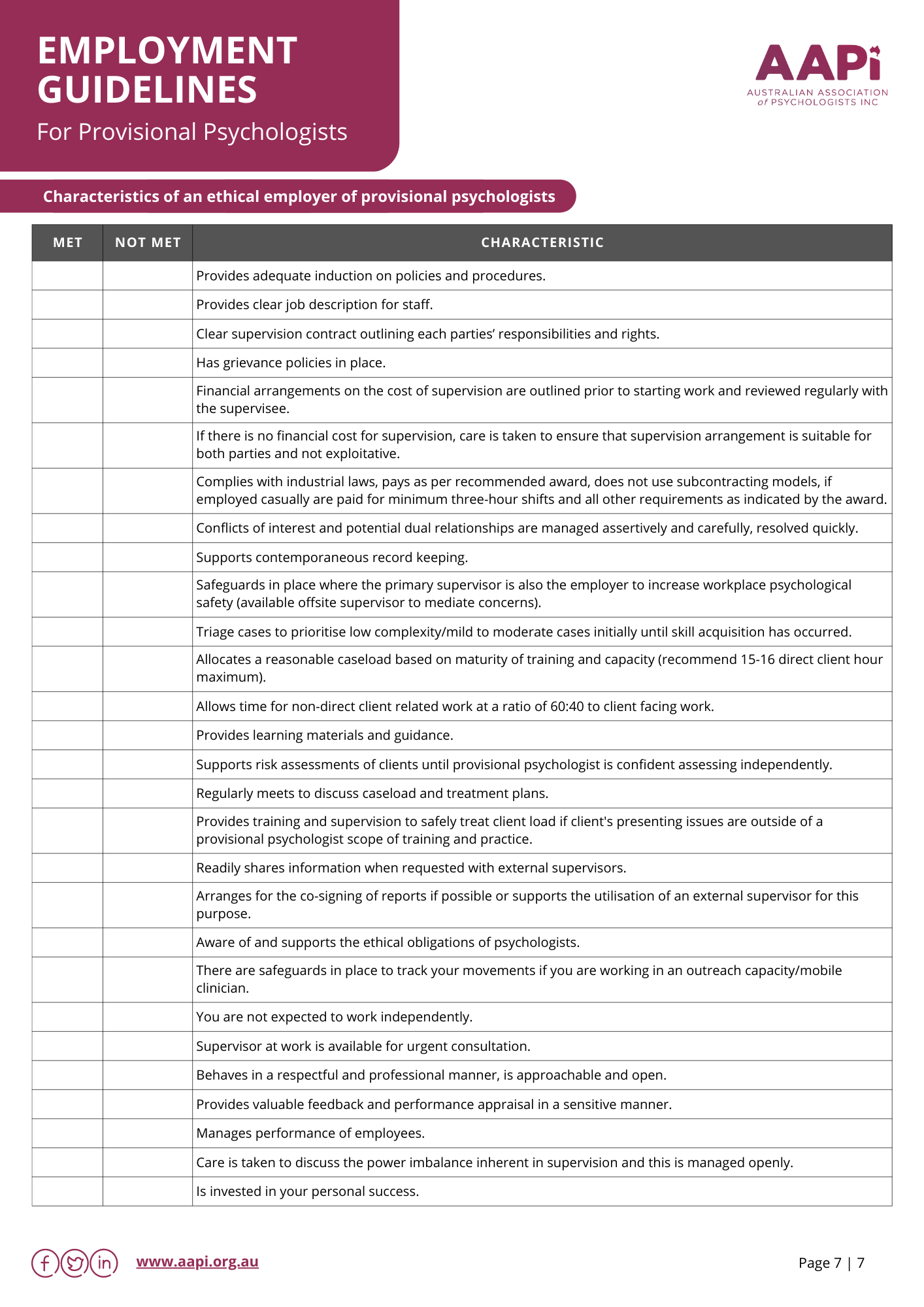
Click on the image to download the checklist.