
Commonwealth Prac Payment expanded to psychology students
As many members will know, securing access to the Commonwealth Prac Payment for psychology students has been one of AAPi's key advocacy priorities over the past several years.
Together, we have taken this issue directly to Parliament House, where psychology students courageously shared their experiences of placement poverty with Members of Parliament. We have met with Ministers, Shadow Ministers and crossbench MPs, worked alongside allied health organisations, advocated directly to government, and asked our members and the broader community to support parliamentary petitions calling for psychology students to be included in the scheme.
Today, we are pleased to welcome the Australian Government's announcement that the Commonwealth Prac Payment will be expanded to include psychology students undertaking professional placements.
The expansion is expected to commence from 1 July 2027. Under the current arrangements, eligible students receive $338.60 per week during their mandatory clinical and professional placement periods. The payment is means tested, benchmarked to the single Austudy rate and indexed annually. While it will not remove all of the financial pressures associated with placement, it represents important recognition of the significant burden faced by students required to undertake extensive unpaid placements.
The initial Government announcement referred to "clinical psychology", creating understandable concern that eligibility might be limited to students enrolled in a Master of Clinical Psychology.
AAPi immediately sought clarification from the Government and has now been advised that:
Consistent with the existing settings for the Commonwealth Prac Payment program; for Psychology, the intent is that CPP-eligible courses are those that lead to professional entry-to-practice as a psychologist. This includes Professional Pathway Psychology courses (as defined under the Commonwealth Grant Scheme) at Bachelor and Master’s level as part of the approved registration pathway (including with APAC). This includes the Masters of Professional Psychology and all 9 Areas of Practice Endorsement (AoPE).
We will be working with the higher education sector and professional bodies in the coming weeks to ensure shared detailed program understanding and ensure consistent messaging, noting we have used Clinical Psychology as a education portfolio term and not in its industry/professional sense.
As discussed, we would like to work with you and other professional bodies on wording for our Factsheet to ensure consistent messaging.
AAPi has spent considerable time providing education regarding this topic.
Funded paid placements are a significant step forward for psychology students. Every year, students complete hundreds of hours of compulsory placement while balancing study, employment and the rising cost of living. For many, placement requirements substantially reduce their capacity to earn an income, creating financial hardship and, in some cases, threatening their ability to complete their training.
AAPi has long argued that these financial barriers affect not only students, but also Australia's future psychology workforce. Supporting students during their placements helps improve access to training and strengthens the pipeline of psychologists entering the profession.
This outcome reflects years of coordinated advocacy by AAPi, the Australian Allied Health Professions Association (AHPA) and many allied health peak bodies across Australia. We also acknowledge the leadership of Independent Senator David Pocock and Independent MP Dr Helen Haines, who worked tirelessly to keep placement poverty on the national agenda and championed the need for greater support for students undertaking mandatory placements.
We also thank the more than 43,000 Australians who signed the national petition calling for an end to placement poverty, and the many psychology students who shared their personal experiences. Their willingness to speak up helped demonstrate why reform was urgently needed.
While this announcement is a major achievement, AAPi will continue working with the Australian Government to clarify the detailed eligibility criteria, implementation timeframes and application process. We will also continue advocating to ensure the final program guidelines fully reflect the Government's stated intention to include professional psychology pathway courses leading to registration.
This announcement is a significant investment in the future psychology workforce. By reducing financial barriers to completing professional training, it will help create a more accessible, equitable and diverse profession while supporting more Australians to pursue a career in psychology.
Further information is available here.


Following sustained advocacy from AAPi, the National Disability Insurance Agency (NDIA) has released a revised version of the NDIS Pricing Arrangements and Price Limits 2026–27 (Version 1.2), published on 22 July 2026, which now explicitly includes guidance on billing for provisionally registered psychologists.
This outcome did not occur automatically. AAPi identified the omission of provisional psychologists from the original pricing schedule immediately after its release and raised the issue urgently with the NDIA. We worked closely with the Agency over recent weeks to explain the practical implications for providers, participants and employers, and repeatedly requested that the pricing schedule be amended to provide clear billing guidance. We are pleased that the NDIA has now issued a revised schedule addressing this important issue.
Read our detailed member update outlining the changes, what they mean for provisionally registered psychologists, and the impact for NDIS providers and participants.
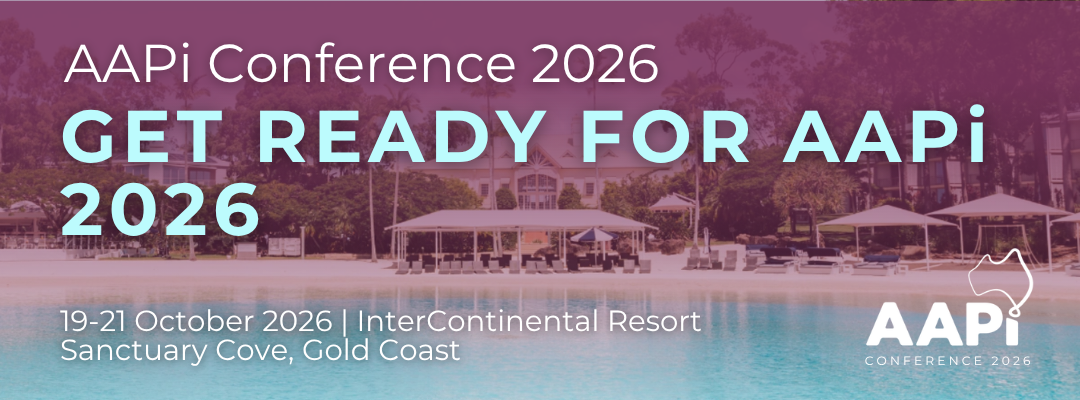
We’re excited to be counting down to this year’s conference, which is now just 88 days away!
Bringing together leading psychologists from across Australia, the AAPi 2026 National Conference promises an inspiring and enriching experience designed to spark new ideas, strengthen professional connections, and elevate your practice.
Personalise your conference program
This year’s conference program features two concurrent streams, offering an even broader range of topics, perspectives, and practical learning opportunities across the profession of psychology. During registration, simply select your preferred sessions for each day, and they will be added to your personalised conference itinerary.
Start your conference strong
Looking to get even more from your conference experience? Enhance your registration by adding one of our Pre-Conference Workshops being held on Monday 19 October, before the main conference kicks off on Tuesday 20 October. These immersive half-day workshops provide practical, hands-on learning and the opportunity to explore key topics in greater depth.
The social highlight of the conference
One of the highlights of the conference is our Gala Dinner - an evening to celebrate our profession, reconnect with colleagues, meet new faces, and enjoy great food, entertainment, and conversation in a relaxed setting. If you joined us at our 2024 Conference, you'll no doubt remember the fantastic energy of the band 'Franky Smart', and we're delighted to welcome them back this year! Renowned for their high-energy performances and crowd-pleasing repertoire, Franky Smart are sure to deliver another memorable night of live entertainment and dancing. Whether you're catching up with old friends or expanding your professional network, it's an event not to be missed. Explore highlights from past events here.
Access sessions beyond the event
As an added benefit, all delegates registered for the two main conference days will receive complimentary access to recordings of the main conference sessions (pre-conference workshops are not included), offering you the flexibility to attend the sessions that interest you most in person, then revisit your favourites or watch the sessions you couldn't attend, after the conference.
Join us in October for what promises to be one of our most inspiring, engaging, and memorable conferences yet.
Register today!

The Overuse of Mental Health Labels
AAPi Director Dr Naomi Malone joined 2GB last week to discuss the growing tendency to use terms like "narcissist" as everyday labels. Dr Malone explained that while diagnostic labels can be valuable in clinical settings, they are often overused or misapplied in everyday conversation and on social media, which can be misleading and harmful. She encouraged people to use these terms with care and seek professional assessment rather than relying on self-diagnosis or online information.

The NSW Department of Communities and Justice (DCJ) has published new information about the implementation of the Thriving Kids program, including further details about the future role of private allied health providers.
Private allied health panel planned
DCJ has confirmed it is exploring the establishment of a procurement panel for private allied health practitioners, with further information expected from September 2026.
The panel may be used to engage private practitioners to:
- provide in-reach allied health support to supported playgroups and peer support groups
- deliver individual or group therapy under targeted supports
- provide flexible service delivery in areas with limited allied health workforce capacity.
The final approach will be informed by the outcomes of the current procurement process with non-government organisations (NGOs) and the establishment of NSW Government-delivered targeted supports in some locations.
Private allied health providers that participated in the Tranche 1 Expression of Interest will automatically receive updates as further information becomes available.
Workforce transition planning
DCJ has also advised it will work with industry groups (including AAPi) to develop a sector and workforce transition plan to support a skilled and sustainable workforce to deliver Thriving Kids services. Further details on this work are expected in the coming months.
Future procurement opportunities
Looking ahead, DCJ has outlined several upcoming opportunities:
- September 2026 – Further information on the proposed private allied health practitioner panel.
- Late 2026 – A second procurement tranche is planned following completion of the current procurement process.
- Mid-2027 – Contracts from the second procurement round are expected to commence.
The second procurement process is intended to support Aboriginal-led service models and address remaining gaps in service coverage.
AAPi will continue to monitor the rollout of Thriving Kids and advocate for the important role psychologists and other private allied health practitioners play in delivering timely, high-quality care for children and families. We will provide further updates as more information becomes available.

Exciting news for provisional psychologists!
AAPi is pleased to share that the Department of Health, Disability and Ageing has approved both Provisional Psychologist Hub and CatholicCare Victoria Tasmania to deliver supervision scholarships under the Addressing Critical Psychology Shortages program.
Over the next four years, this initiative will provide access to 600 funded supervision scholarships for provisional psychologists undertaking the 5+1 internship program.
Provisional Psychologist Hub has been approved to deliver 250 part-time scholarships, while CatholicCare Victoria Tasmania has been approved to deliver 350 full-time scholarships. As part of this partnership, supervision services for CatholicCare Victoria Tasmania scholarship recipients will be delivered by Provisional Psychologist Hub.
These scholarships are designed to support psychology practices of all sizes. By attaching the scholarship support to the individual provisional psychologist, the program promotes equitable access to quality supervision opportunities across Australia, supporting provisional psychologists working in a diverse range of practice settings, including small, medium, and large organisations.
This significant investment will help strengthen Australia's psychology workforce by reducing financial barriers to supervision, increasing access to quality training and supervision, and supporting more provisional psychologists as they progress towards general registration.
The Addressing Critical Psychology Shortages – Supporting Provisional Psychologists to Practice program is supported by grant funding from the Australian Government.
Check Eligibility and Apply Now.

If an NDIS participant or prospective participant disagrees with a decision made by the National Disability Insurance Agency (NDIA), they have the right to request a review of that decision. The first step is to apply for an internal review with the NDIA. If they remain dissatisfied with the outcome of the internal review, they may then apply for an independent external merits review through the Administrative Review Tribunal (ART).
Reviews may relate to decisions such as eligibility for the NDIS or the supports approved as part of a participant’s plan. Support is available through the NDIS Appeals program, which provides free assistance from experienced disability advocates to help participants understand the review process, prepare required documentation, seek legal assistance where appropriate, and participate in the ART process.

The Department of Veterans’ Affairs (DVA) is seeking expressions of interest from allied health providers interested in contributing to future consultation activities relating to veterans' health and allied health service delivery. This is an opportunity for psychologists working with DVA clients to help inform future policy and service design.
Expressions of interest close 5:00pm AEST on 31 July 2026. Members can find further information, including eligibility requirements and how to apply, on the DVA website.

The Australian Psychology Accreditation Council (APAC) is seeking applications from experienced individuals interested in joining its Board of Directors.
This is an opportunity to contribute to the strategic direction of Australia's independent psychology accreditation authority during a period of significant change across psychology education, accreditation and workforce development.
Applications close 5:00pm on Tuesday, 18 August 2026.
.png)
To mark Birth Trauma Awareness Week, PANDA has released a new online course for healthcare providers, Understanding Birth-Related Trauma. Developed in collaboration with Birth Trauma Australia and informed by insights from the PANDA Helpline and lived experience community, the course provides an introduction to birth-related trauma and practical guidance for supporting parents following a traumatic birth experience.
The 30 minute course is designed to help healthcare providers better understand birth trauma and support parents to feel heard, informed and empowered throughout their recovery.

The Black Dog Institute has released a practical new toolkit designed to help youth support professionals have safe conversations with young people about mental health and treatment options.
While developed for youth workers and other frontline professionals, this resource could also be valuable to share with parents or carers. It includes practical guidance on recognising signs of distress, discussing treatment options, navigating support services and encouraging healthy coping strategies.

Paid Parental Leave expands to 26 weeks
From 1 July 2026, eligible families can now access up to 26 weeks of Government-funded Paid Parental Leave. The expanded scheme also includes an increased payment rate of $1,004.70 per week and higher income eligibility thresholds, making more families eligible for support. The changes form part of the Australian Government's ongoing expansion of Paid Parental Leave, which also introduced superannuation payments on leave from July 2025.
eSafety report highlights ongoing gaps in online safety protections
A new report from the eSafety Commissioner has highlighted ongoing gaps in how major online platforms are responding to child sexual exploitation and sexual extortion. The report found that while some platforms have made improvements, significant challenges remain in detecting and preventing online harms, including the use of technology to identify coercive behaviours and improve reporting pathways. eSafety noted that sexual extortion continues to have serious psychological and emotional impacts, particularly among young people, and called on technology companies to strengthen safeguards and response systems.
National report highlights ongoing mental health stigma
The Mental Health Commission, in partnership with SANE Australia, has released the first National Stigma and Discrimination Report Card, revealing that despite growing awareness of mental health, most Australians living with mental health challenges continue to experience discrimination in their everyday lives.
New support for Australians impacted by CTE
Dementia Australia and ConneCTErs Australia have partnered to expand support for people living with suspected or probable chronic traumatic encephalopathy (CTE) and their carers through a pilot program funded by the Australian Government’s $12.4 million CTE Support and Prevention Program. The initiative will deliver support group sessions across 11 locations throughout Australia, including major cities, regional areas, and online, providing access to information, education, connection and wellbeing support for those affected by CTE.